-->
Today we are interviewing Tyler Hall about his poetry anthology, titled “Atop the Bookshelf.”
Tell us a bit about yourself.
To explain myself would require not just a paragraph, nor entire chapter or book, but a library’s worth of volumes. But here are a few facts about me: As of this interview, I am a security officer with a strong sense of justice and truth. I love cats, Japanese Anime, cosplaying, acting (I have written, directed, and starred in a handful of short films), watching ASMR (autonomous sensory meridian response) videos on youtube, drawing, exploring new places and shops in my hometown of Jacksonville. Along with the annual trips to North Carolina and regular visits to Pop Culture Conventions, one could say I am a man of many tastes and interests.
Describe your anthology of poetry, “Atop the Bookshelf,” in a few sentences.
“Atop the Bookshelf” is my attempt at the poetry genre. While I see myself as more of a novelist, even the best writers cannot limit themselves to one genre or one format. I believe a writer should be versatile in their craft. That is why I have chosen to write in every type of poetry imaginable and in every genre imaginable. Focusing on one type of poetry or genre of fiction is, in my opinion, self-limiting.
Who do you think would most appreciate your anthology?
Depends on whom I inspire with my words and who desires to read my work. If anything, Atop the Bookshelf covers every genre, and do I mean every genre! If you like adventure, it’s got adventure. If you like fantasy, it’s got fantasy. If you like a little science fiction, I added that as well! For those who enjoy reading religious texts, I have poetry that covers religion as well! I've even added a few comical poems for those who enjoy a good laugh! In short, there is something for everybody in "Atop the Bookshelf"!
What first got you interested in poetry?
I would have to say my interest in poetry would stem from the brief, yet vivid descriptions of the events and situations of the overall text.
Your anthology contains a variety of styles, from haiku to traditional rhyming. Do you have a favorite type of poetry?
I cannot simply choose a favorite style as every style has its own strengths and weaknesses. For example, while Haiku is very vivid in so few words, it is also simplistic. Traditional rhyming is considered to be the “standard” of poetry, however it’s very limiting with the constant rhyming.
 |
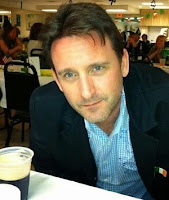
| Tyler Hall. |
Where do you get your inspiration for your poetry?
For me, inspiration would have to come from everything I like. Be it nature, history, art, or what strange things my mind can cook up! If you could see my fantasies and my thoughts, it would outlandish and farfetched! Oh trust me on that!
I would like to be, for once in my life, the guy who lives in a big palace with a lot of people...a wacky, wizard inventor, a lot of cute girls in legwarmers and oversized t-shirts, a few elves, fairies, ninjas, professional wrestlers, space aliens, a couple of soldiers, cats, super heroes, a robot,, a Christian pastor and a French chef to go along with it...why all this? I do not know! Let's add a library, a film studio, a theater, and a giant kitchen complete with a stockpile of food to go with these people as well! Oh, and did I forget the people in this fantasy live on island which is also its own country among other things? No? Well, now you know! This is just to help you visualize my intense imagination!
Usually my work does slide between silly; for those moments I chose to be funny, to those moments where I chose to be extremely serious.
Who is your favorite poet?
I do not have a favorite poet as I am more of a novelist than a poet. However, if I had a number of poets whose works I need to read more, they would include Walt Whitman and Lord Byron. Perhaps there are more, but for the time being, I am going to stick with those two. I also want to read “The Odyssey” in its entirety.
Does writing ever take you to unexpected places or reveal things you hadn’t thought about before?
Absolutely! There are so places a many writer or reader can visit in words. Perhaps the same can be said about the various peoples, cultures, and nations one can meet in the words of a writer. The sad truth, however, is while these places are amazing, readers and writers alike will never be able to visit these worlds for real.
And that is not just limited to locales either! Experiences such as meeting someone out of the ordinary or a sentient being who isn’t human! Now that would be an encounter in itself! As I said before about having my life go from mundane to magical, meeting someone like that would be awesome.
Earlier, I said something about wanting to live in a big house with a lot of unusual characters like ninjas, elves, and a wacky inventor. While something that may never happen to me in real life. In the realm of fiction, however, anything goes. Perhaps I could write a novel about something like that!
Do you have a favorite poem in your collection?
That’s hard to choose because I love every single one of my poems. If I had to choose which poems were the best write, I would have to choose "Sinking of the Mary Lee" because of its tragic story, "Joker Junction" on account of the hilarious tale behind it, "Sylvester the Firebeard" largely in part of its title character and its events being so life like. (One can feel the heat of the flames and smell the scent of gunpowder!)
I also enjoyed writing "Tapestries", and "Atop the Bookshelf" (the poem for which the anthology is named for), mainly as they took two seemingly mundane objects and turned them into something worth observing closer. "Sniper", because it depicts a soldier in a battle. "A Man Named Paul", "Judas", and "The Apostle Peter," would have to be listed because they were all in relation to the three men mentioned and their Biblical importance.
As for "Elizabeth", is a poetic rendition of the Tad Cummins Case. It was one of those poems I knew I had to write because of how the news of that crime affected me. Just as there have been poems and songs written about historical events and people. Which is mainly why I wrote “Orville and Wilbur” as it was about the Wright Brothers’ flight in Kitty Hawk. Lastly, “Aurora Borealis” was written because seeing the polar lights is something on my bucket list. "A Fan Named Ann" was something I wrote to reflect about a football game where I once provided security.
Now, the fun poems to write were the haikus and the quatrains. Some were foreboding and others were light hearted and positive. Believe me, those were the best to write! You could see so much in so little words!
I am quite certain there are a number of poems I’ve left out. Time constraints do not allow me the opportunity to explain every poem in Atop the Bookshelf. Yet, I will say that most of my poetry was written because I felt strongly about a topic or something was on my mind.
Now if I had to name one of my poems that had a good premise, yet a poor delivery, would have to be “K’Yakcha”. I wrote it as a means of recapturing the epics of Old akin to “Beowulf” and “The Iliad”. Yet, “K’Yakcha” seems to have missed the mark. Those who read it may say it was reminiscent of those epics, but I just feel it’s not up to par.
Do not get me wrong though, I enjoyed writing “K’Yakcha” because creating a modern day epic was a challenge in itself. However, I feel by its stilted prose, “K’Yakcha” simply doesn’t measure up to the classics. What I will say to my readers is if you are put off by the awkward wording found in “K’Yakcha”, let me just say it helps to think like a translator. Intelligent readers will understand the meaning of my words.
“Ode to David” was a decent one to write as well. However it is not as good as it should have been. “Oasis”, “Waiting Room”, “A Date with Death”, and various others would also fit in this latter category. By that, I mean poems that were good ideas, but not the best written.
Perhaps it is best if I let my readers decide which poems were my best and which poems were my worst.
Can you tell us a bit about your writing process?
I love writing at night. I do not know why, but there is something about its tranquility that appeals to me. The same can be said about writing on a rainy day. Another tactic which helps is listening to music and ambience to help with visualizing a scene or dialogue.
What was the most challenging aspect of writing poetry?
The most challenging part of poetry is showing the most with the least amount of words. I've had to remove words which felt out of place. Another challenging aspect of poetry is the plot, theme, and subject matter. I've even had to remove poems from "Atop the Bookshelf" because I felt they were not good enough.
What do you hope readers will gain from reading your anthology?
That would ultimately depend on what my readers desire from my words. Some of my readers are probably seeking entertainment. Others are most likely desiring a deeper meaning.
How have readers responded to your anthology so far?
Sadly, there have not been many readers. One of the many tragedies of being a writer is not having any readers. More than fame and riches, a writer should be more concerned with gaining readers FIRST and FOREMOST.
In ten years, where would you like your writing career to be?
I would like to have at least some of what I desire to create to be published by this time. Believe me when I say that would be a major advancement in my career.
As of this interview, I am working on creating my facebook fanpage so fans of my work can congregate and keep up with the latest about my work.
How do you feel about the increasing popularity of ebooks?
I am divided on the issue of ebooks. For me it is a two-edged sword with its pros and cons. For the pro side of ebooks, they are environmentally sound in reducing the consumption of resources. However, when it comes to the cons, one of the most upsetting attributes of ebooks is how they are reducing the concept of brick and mortar book stores.
For me, going to a physical location for books and tests is more appealing than computerized ebooks. I say this because of the personal interaction with fellow readers and aspiring authors.
What do you have in mind for your next writing project?
I cannot further disclose much about what I have in the works. The reason being is I have learned it is best not to announce your plans or goals. It is mainly because if I were to do that, I would be less motivated! For any future projects I have in store, one will have to wait and see!
Is there anything else you'd like potential readers to know about your anthology?
I choose not to disclose that as I would rather let my readers discover for themselves. To say much more would ruin it for my readers.
More Information
Buy "Atop the Bookshelf" on Lulu.
Today we are interviewing Graham Old about his comedy/memoir/fiction book "Of Madness and Folly."
Tell us a bit about yourself.
My name is Graham Old. I am a working-class Brit, staunchly anti-establishment and a wimpy pacifist. I'd be a revolutionary communist or anarchist, if I could justify throwing bricks at department store windows or guillotining the rich. (Note: I reserve the right to re-visit that intention once I'm rich and famous!) I guess I'm what they call a champagne socialist, if I could afford the champagne.
I am a former missionary, church leader and university chaplain. I have also worked in Social Services and for adults with Learning Difficulties. I am currently a certified Hypnotherapist and work in private practice.
Describe the plot of your new book in a few sentences.
Rob Auldam is a Social Worker with a love of red wine and a diagnosis of Aspergers. Following a drunken incident of self-harm he is admitted as a psychiatric patient. There, he discovers a world of unexpected humour and learns that we are all a little bit crazy.
Who do you think would most appreciate this book?
I hope that the book will appeal to anyone who enjoys comedy books. Although the content might be considered dark, gritty or 'unsuitable for minors', my intention is that the humour throughout the book makes the raw expereinces within digestible and strangely enjoyable. I also hope that it appeals to people who have an interest in mental health, autism, self-harm or have ever wondered what life inside a 'mental hospital' is really like.
What inspired you to write a fictional comedy memoir?
I think there were three sources that lead to me writing this book. Years ago, my brother and I were talking about the surreal experience of working within social services. We briefly toyed with writing a sitcom set within that environment, but concluded that if it was true to our experiences, it would be dismissed as unbelievable! Although this book is not set within Children's Services, that serves as something of a back-drop.
Secondly, I read the book Reasons to Stay Alive by Matt Haig, which is an account of his journey through depression. I cannot recommend that book highly enough.
Finally, I re-read Philip Roth's magnificent Portnoy's Complaint. Reading Roth and Haig in close proximity persuaded me that it was possible to discuss topics that were deeply theoretical and essential – like ethnicity, sexuality and identity – but to do so in a way that was humourous and engaging.
Tell us a bit about the protagonist, Rob.
I love Rob! I think of him as something like Sheldon Cooper from The Big Bang Theory. But imagine a Sheldon who desperately wanted to be liked and was fully aware of his own foibles.
Rob is a Social Worker and also works as a Life Coach. He had a less than perfect upbringing, though in this book you only receive vague details of that. Rob was also diagnosed with Asperger's a few years ago and is probably still in the midst of reviewing his life's history and figuring out the part that Aspergers played in all of that. As such, Rob has experience of mental health and family crisis from both sides of the fence. He is perhaps the epitome of a 'wounded healer'. Yet, rather than giving up, he stubbornly believes he can really make a difference in people's lives. He should probably have quit some time ago!
Rob, as an autistic social worker, is a unique character. What steps did you take with your writing to make his character feel authentic?
I kinda feel like I cheated with this one. Due to my own work in Social Services and in private practice, plus some family insight and personal first-hand knowledge, I can probably relate to Rob more than you might think. However, I wrote and re-wrote every line that he said and every internal monologue he had. I then asked friends and family to read them.
The reaction I was hoping for was 'believable shock'. I wanted people to be offended, but to accept that Rob meant well. If they weren't offended, then I was pulling my punches. If they actively dis-liked Rob, then I had gone too far. I hope I've achieved a realistic balance. I want people to feel for Rob, whilst also thinking that he's a bit of a well-meaning jerk. There's a good tradition of characters like this in British comedy, such as Basil Fawlty or David Brent. Rob doesn't have a malicious bone in his body, though his quick judgements and self-imposed isolation may cause you to think otherwise.
People with autism are not always perceived in the best light in media. They might be treated like non-emotional automatons, or heartless self-centred nerds. I have tried to create a character for whom you will feel some sympathy, perhaps even admitting that you like him, whilst acknowleding his own unique perspective on the world. In a sense, the character of Rob is the most important part of the book.
Humor is a big part of this novel. Has humor always been important to you? Or did it develop as you wrote?
Humour is HUGELY important to me. I guess I have had a fairly unqiue work history, which has included giving sexual advice to adults with learning difficulties, counselling elderly parishoners who have lost their life's Love and mentoring teenage Dads with a glue habit. Humour has been an essential part of empowering people in such situations, often the only effective way to seeing the possibility of a hopeful future. Aside from that, it strengthens the practitoner in such situations.
We all know the stereotype of the bullied fat kid who turns to comedy to win-over his classmates. It's a stereotype because it happens again and again. There is something about the power of comedy that can change people, challenge roles and stereotypes and set us on a new path. I'm not saying it's easy – and anyone who dabbles in comedy whilst talking about ethnicity or prejudice needs to have balls of steel and a sharp wit – but I do believe that comedy can open doors that may otherwise be firmly shut.
So, I wouldn't dream of talking about mental health without injecting humour throughout. To suggest that such an environment is devoid of humour simply devalues those living through it. If you think that nothing funny ever happens in a psychiatric hospital, you are simply refusing to acknowledge the absurdtiy and humanity inherent in such an arena.
Are there any authors who have influenced your writing style?
Charles Bukowski, Matt Haig, Kurt Vonnegut, David Sedaris and Mark SaFranko. I have oodles of respect for authors who can take subjects that shouldn't be funny and fill them with humour. This strikes me as a uniquely human thing to do. Who hasn't had that experience of being in a stressful or traumatic situation and feeling the relief that a moment of humour brings?
Tell us about your creative process, from initial idea to published manuscript.
I tend to start by 'brain-storming'. I don't write any stories or dialogue, but I jot down scenes or headings that occur to me. I'm looking for things that are funny and significant. I avoid any out-and-out jokes, because they seem cheap and lazy, but I'm looking for the ludicrous and authentic.
I then read whatever fiction books I currently have on the go. It's a bit of an act, because I convince myself that I'm just reading to enjoy reading-for-reading's-sake. Yet, it's obvious that I am digging deep for inspiration. I focus on authors who write i) well, ii) realistically and iii) humorously. David Sedaris would be a good example.
I then return to my headings and look for one or two that feel like they have potential. Anything that feels like it is trying too hard to be funny gets rejected immediately. (I'm not just after laughs for their own sake.) I flesh out one or two ideas and at some point I get caught up in the flow of writing. When I look back on my day's work, I might have combined half a dozen of my early ideas without having been aware of it. When I have a handful of 'episodes', I send them off to some trusted friends who have my full persmission to pull them to pieces. They know about my desire to be funny yet authentic and help me to shave-off anything that is lacking in either of those areas.
Recently, it's become important to me to read my work out-loud. When I have the bulk of a chapter, I will read it aloud to get a feel for it. I'm looking for anything that feels forced. I know that something is genuinely funny if I still chuckle to myself on reading it through. Although I obviously know the punchline, it should still be funny enough to provoke a reaction. After all, I still laugh when watching Curb Your Enthusiam, Fawlty Towers or Only Fools and Horses, even though I know what is coming.
Finally, I send out the full book to another group of trusted readers. I give them no idea at all what to expect and that is the most nerve-wrecking. Obviously, not everyone will share my sense of humour or sensibilities. However, at the very least, I'm looking for them to agree that it is well-written and insightful. I then re-read the whole manuscript again and again.
How do you feel about the increasing popularity of ebooks?
In an ideological sense, I don't have a problem with it. However, I personally still prefer to have a book in my hands. If I read an ebook that I love, I will most probably buy a hard copy, just to hold it in my hands.
However, I'm slightly concerned with the inequality that ebooks and kindle deals can bring. Perhaps if Libraries stocked kindles or ipads, so that people could check them out for 3 weeks and make the most of the 99p deals, I'd feel slightly happier with the situation. I'm not sure what the answer is there, but I think it's more than achievable.
What are your goals as a writer for the next ten years?
I'd like to make enough money to buy J. K. Rowling.
Failing that, I would like to write comedy so well that it gets taken seriously. Comedy books can be seen as 'light' reads, which I think does the genre a real disservice. Unless I am completely wrong about all of this, comedy books are able to tackle the 'heavy' subjects in a way that nothing else really can.
If I can be a part of that, I would be thrilled. If I can have a ride at Disney Land named after me, even better!
Is there any aspect of writing you don't like?
Reading and re-reading the final manuscript. I'd like spell-checks to reach the point where they genuinely know what you mean and we can trust auto-correct to do its job. Frustratingly, when you know what you want a sentence to say, your mind plays tricks on you and you're convinced it actually says that. It's embarrassing to read a manuscript for the 19th time and find a rogue spelling mistake!
What do you have in mind for your next project?
I would like to continue exploring the life of Rob Auldam. As he is based very much on a composite of me and those I have known, we have naturally had some shared experiences. I would like to write about his experiences as a Social Worker, bringing my conversation with my brother full-circle. I would also like to write a little about his experiences of religion from the inside.
In a sense, I want to look at some of the archetypal experiences that many of us go through, yet never talk about. And I want to find the humour within, to allow us to talk about them.
Is there anything else you'd like potential readers to know about your book?
More of it is based on the reality of my life than I'd ever admit! :) Also, you probably shouldn't let your children read it.
An excerpt from "Of Madness and Folly":
I will begin with today, which started - as all good days are prone to do - with a rude awakening.
For whilst I was happily biting Scarlet Johansson's lower lip, Charge Nurse Grace was knocking on my bedroom door and calling my name. It is a peculiar feature of dreams that the mind seems capable of incorporating outside noises and distractions, without them appearing out of place or incredulous. How many times was my adolescent mind indulging in darkly perverse yet deeply satisfying fantasies, whilst my mother was standing at the bottom of the stairs, yelling at me to wake up for school? Yet, my dreaming mind, aroused and unfazed, included my mother's voice within the content of my fantasy, no doubt encouraging me to "Get up!" and "Come-On!", whilst I protested that I didn't need her encouragement and knew very well what to put where, thank you very much!
No, no, we are not yet ready for tales of childhood trauma or the blurred lines of my adolescent mind. Let's return instead to my mind, such as it is, today. Unsurprisingly, the sound of Nurse Grace's voice invited her into my dream, where she knelt at the head of my beloved Scarlet. The sumptuous ruby lips of Ms. Johansson had finally met their match in Grace's generous enticing bosom. A Kenyan woman, with an imposing backside, Nurse Grace was a wonderfully welcome stereotype. As she bent over Scarlet's now smiling lips, Grace's uniform began to slowly unbutton from the top, of its own accord.
I had just about caught a glimpse of the outer lace of a surprisingly seductive purple bra, when the sky exploded into a field of brightness and I awoke to find my door open, my bedroom light on and Nurse Grace standing at the foot of my bed.
"Are you up?" She asked.
I am, in retrospect, painfully aware that my porn movie training - which has consisted of digesting at least half of the content of the entire World Wide Web - should have equipped me to respond, "why don't you check for yourself?". However, I meekly uttered a breathless "yep", whilst sitting up, hoping that my beer barrelled belly would cast its shadow over my Depravity and hide my shame.
"Breakfast", Nurse Grace grumped and swiftly left my room.
And, so began day 29 of my stay at Greenfields Psychiatric hospital.
More Information
Buy the ebook on Amazon UK
Buy the paperback on Amazon UK
Check out Graham Old's Twitter
Find the book on Goodreads
Today we are interviewing Thorkin Nailsson, author of the satire/parody book "The Kuk of Valhalla | The Autobiographical Sagas of Norway’s Legendary Porn Star, Thorkin Nailsson."
Tell us a bit about yourself.
Thorkin Nailsson is the pen name of Craig H. Hellekson. I write under both names depending on the subject matter. When I’m not writing, I’m reading & as of late, combing through my cat’s plush fur for ticks.
Describe the plot of "The Kuk of Valhalla" in a few sentences.
An absolutely fictional account of young Thorkin Nailsson’s youth in the small – and criminally bizarre – Norwegian Village of Gørpeland. During this time in young Thorkin’s life, he struggled with uncommon feelings for his Mor (mother), who worked primarily as the village prostitute. He also struggled with addictions to pornographic magazines and psychedelic mushrooms.
Who do you think would most appreciate this book?
Readers who enjoy the absurd and don’t take offense too easily…I can’t stress that last part enough. IF that’s you…I’m certain that you’ll be entertained by this relatively short tale.
What inspired you to write a spoof of classic Icelandic/Scandinavian historical sagas?
My idea was to create a pen name to write more racy material. Out of this, I thought it might be fun to create a whole, fully-realized Thorkin Nailsson persona of an old washed up Norwegian Porn Star. In the classic sagas, there are tales of bravery, love, war, and struggle…I wanted to incorporate those themes and style into something absolutely twisted.
Tell us a bit about the protagonist, Thorkin Nailsson.
Young Thorkin discovers very early that he is an enthusiastic, budding sex-addict, a moron, and a visionary of questionable morality. Without a real father figure around and mother who is selfish, generally drunk, and the village whore, he is left to raise himself. This leads to a huge amount of internal conflict resulting in a conclusion that most typical readers will find a bit revolting and hilarious…it’s those readers that I’m after.
 |
| Author Thorkin Nailsson |
Humor is obviously a major part of this book. Has humor always been important to you or is it something that you’ve only recently started exploring?
No matter my intention at the outset of a story, my writing always seems to drift toward humor and the absurd. I believe most writers will tell you that the genre chooses you, you don’t chose it. You naturally end up writing what you’re good at. My personal goal is not to recycle the same themes over and over…to be fresh and original…that’s my biggest challenge.
Are there any authors who have influenced your writing style?
In my opinion, no single writer creates a character better than Stephen King, he’s a true master. Making people you care about – that you’re invested in – and that you will follow, no matter what sick thing they may do…to me, that makes for the most compelling read. I don’t write like he does (nobody does), but that’s the lesson I try to remember when I’m creating people in the page…make them real…make your readers care. The one writer I try to ape as much as possible is Douglas Adams. I am failing at it. I love every word he wrote.
How do you feel about the increasing popularity of ebooks?
I like choices…be it food, music, cars, I like a selection… With the growth of ebooks, I now have many more reading options, not just a selection of what the publishers are willing to distribute, but what the many talented writers who don’t have publishing deal are creating…and let me say, that I’ve read some outstanding books from part-time authors. With that, I think we all have a duty to ensure the best product goes forth and not malign the shaky reputation that self-published writers already face.
Is there any aspect of writing you don't like?
Proofreading. I used to edit my own stuff – huge mistake - I now hire a pro to help me get it right.
Have you ever had writer's block? If yes, how'd you deal with it? If you have not had writer's block, why do you think you haven't?
Of course. I think anyone who writes frequently (daily for me) gets blocked up occasionally. For me, the better rested (i.e., not hung over) I am, the more creative I am…it’s bonkers if I try to write still shedding the bad decisions of the previous night…best to just pack it in. If the creativity isn’t there…there’s always editing to do…social media to water…and book promotion endeavors to attend to. I keep busy.
Do you write with a computer, typewriter, or pen and paper? Why do you use this tool?
Nothing quaint or romantic…just my trusty laptop, which is always with me.
Do you plan to write more books featuring Thorkin Nailsson?
My goal was to write 4 or so fictional autobiographical sagas on his life leading from Gørpeland to his eventual exile from Norway and into obscurity. Hopefully, "The Kuk of Valhalla" will be well-received and will spur my desire to become Thorkin sooner rather than later. Thus far, the feedback has been encouraging. As for the Thorkin Nailsson pen name…absolutely! Already working a new one!
Is there anything else you'd like potential readers to know about your book?
Sure, to you readers with a twisted sense of humor who enjoy a journey into the strange, I encourage you to check out "The Kuk of Valhalla." If not for anything, just to say that you’ve read the first “MockUSaga,” or “SagaSploitation,” book ever written…a genre that “Thorkin” & I created.
An excerpt from "The Kuk of Valhalla":
"The story of
one’s life usually begins in earnest with a tale of fallow fields,
closely followed by starvation, misery and a pathetic mud-streaked baby
clinging to life grappling for milk from a dry teat. Mine will start
essentially the same, with a squirting red, mewling, shitting, and
puking little bundle of Thorkin-joy. An infant that in another time
would have been drowned or scarified at the Temple of Uppsala and served
on a bed of lettuce – or some leafy vegetable other than Kale – to
Odin. To my Mor, I write these opening words for you. Your bastard son,
who you left hanging naked at the end of a rope on the weakest limb of
the Yggdrasil tree. Equally as repressed as the strange fruit hanging
from Billy Holiday’s woeful tree. How I managed to fall and rot into the
ground as a Hellek’smyth only to rise and make quality Adult
Entertainment is a saga worth telling."
More Information
http://craighellekson.com/the-kuk-of-valhalla
Today we are interviewing Dan Alatorre, author of "Savvy Stories: Funny Things I Learned From My Daughter."
Tell us a bit about yourself.
I’m a Best-Selling author and humorist; my brother points out that a humorist is a writer who’s not funny enough to call themselves a comedian. Gotta love family. I turned my sights on fatherhood in “Savvy Stories,” and the results were hilarious. I was just a normal guy until I became a first-time dad at the age of 47 - when most of my friends were becoming grandparents or sending their kids off to college! Some will argue that I was never a normal guy, but nobody will argue that the addition of a bouncing baby girl changed my life. My comedic debut book "Savvy Stories" tells humorous tales about a loving dad who sees the magic in children, and isn't a bumbling stooge about changing diapers like some TV sitcom. I followed up the success of "Savvy Stories" with the even better sequel "The TERRIBLE Two's," and my inspirational book "The Long Cutie," which deals with life affirming stories about people with a rare heart condition.
I also write short stories about parenting and family humor that appeal to everyone. My unique and hilarious short stories include “The Short Years,” “Night of The Colonoscopy,” and “A Quick Trip To BuyMart.”
My success has been widespread and varied. I became a bestselling author (it was a slow sales week at Amazon) and I have achieved President’s Circle with two different Fortune 500 companies (can you believe that?). But I have always been a writer.
I wrote cartoons as a kid, created a newspaper at my grade school, was co-editor of my high school newspaper… I had a desire to tell unique stories in an amusing way. I’m glad my smart aleck sense of humor has found a productive outlet. I’m sure my sarcastic mouth could have just as easily gotten me killed and buried in a shallow grave.
Currently in the works are “FOURthcoming,” the conclusion to the Savvy Stories series, “Chase Me Until I Catch You,” a nonfiction romance short story, and “The Adventures Of Pinchy Pinchy Crab And Ramon D’Escargot,” a children’s novel, and others.
I live in the Tampa area with their dog and cat, and an occasional armadillo (“but we’re working on evicting the @#$% armadillo!”)
Describe your book in a few sentences.
“Savvy Stories” is a heartwarming comedy about a 47 year old man who discovers that he is about to become a father for the first time, and after getting over the shock of having a baby in the house, learns to see life through the eyes of a child. He comes to appreciate and enjoy the many hilarious things that all kids say and do, and creates a lifelong daddy-daughter bond that every parent can appreciate, and that every dad of a daughter should strive for. After all, men were little boys once; we know that territory. Having a little girl is uncharted water. We feel sure we’ll screw her up.
Who do you think would appreciate your book?
I’m surprised anybody does. Oops, did I say that out loud? I meant to say everybody does! This is a book that men and women both enjoy. The parents in the story are real, not idealized; they do real things like shop at Publix and Target, and they do a lot of stuff that we can all look back on and laugh about. Like when the kid discovers a Sharpie marker and writes all over the cabinets. Most of us have kids or were kids once, so we know there is a lot to laugh about. Women have said they appreciated the viewpoint about babies from a dad, and men have said the book was like I was writing about them. Pretty much everybody agrees it’s funny, even people who haven’t had kids. And more than a few have given it as a baby shower gift. When’s this interview coming out? It makes a great Mother’s Day gift, too! And Father’s Day!
Was there an epiphany that revealed you had to write a book about your fatherhood experience? Or did you gradually come around to the idea of writing your book?
There were two.
First, that kids are flat-out freaking hilarious if you are paying attention. Not just my kid, but every kid. A hundred times a day there are amazing moments that come and go so fast - and we’re too busy to take note or to remember it later. I just happened to write some of it down.
Second, they grow up fast. I was 47 when Savvy came along. We had infertility problems so we were especially appreciative to be having a baby at all, but also because I was older I had a different vantage point than most dads at age 22 or 25. My father and my brothers came to me and said, “We missed it, we were working. Take time to savor every moment because if you blink twice you’ll be walking her down the aisle.” Strangers would come up to us in grocery store after a particularly grueling night – I’m sure our weary expressions said it all - and they would tell us, “Enjoy these moments, even the difficult ones.” It sunk in. So I knew that it all happens fast. It doesn’t seem like it when you’re up at 3am feeding a cranky kid who won’t go back to sleep.
But we made that our time. We found ways to make it fun and special, and to realize that one day she’d be off to college and I’d wish I could have another moment with her like this, just me and her, at 3am playing a game of peek a boo. On that day, I’d wish I had this day back. So I learned to love those times. I could never have figured that out when I was twenty five.
As I posted about this stuff on Facebook, friends were constantly telling me it was hilarious and that I should write a book. I resisted, but at some point you have to trust the people in your life who have your best interests at heart. So I wrote a book - and it became a bestseller.
How do you think the perspective of fatherhood that you share in your book is different from other portrayals in the media?
Most dads on TV are bumbling stooges. Mine wasn’t; was yours? Still, it’s rare to see a man step up and say “I can be a great father and learn about gymnastics with my daughter and take her to dance lessons because I love her.” I can make time to blow bubbles on the back porch. It doesn’t cause your man card to be revoked.
Also, in the book you see some very real, very personal moments. The first week of Savvy’s life was the longest week of ours. We spent five days in the NICU (Neonatal Intensive Care Unit) worrying that our newborn daughter might die. It was touch and go for a while, and it was extremely difficult to write about. Chapter two gets a lot of people crying. But because we put that honesty out there, readers said “Okay, I can trust this guy.” Then they were better able to laugh with us, too.
Do you think your experience of being a father is different, having had your first child at 47, than it would have been if you’d had your first child at a younger age?
There is no doubt. I have a nephew whose son is a year older than my daughter. Our worlds are just so completely different. He’s a good guy and a good dad, but it’s a different perspective from what I’m looking at now that I’m fifty. And it should be. He’s building a career, I’m 20+ years into mine and established. He and his friends still party and go out to bars. My wife and I have friends over to the house and are lucky to stay up past 11pm. Okay 10:30.
Humor is a large part of your book. Has humor always been a part of your life or did it develop as you got older?
I came from a large family – seven kids – and I was next to youngest. So to get noticed, you had to stand out a little. Growing up, I had a sibling who was an athlete, another who was a scholar, another who was a musician; I was the smart aleck, and it got positive attention if it was funny. So I always appreciated that and did a lot to get that recognition, even at school. I wasn’t a class clown, because my parents were very strict and because nuns in general have no sense of humor. I mean zero, zip, nada. I wasted some of my best stuff on those old hags! Look at these knuckles - those are ruler marks, and they’re still visible all these years later. But I could usually get out of trouble at home if I could get my mom laughing. That’s a huge ace up your sleeve as a kid.
How would you describe your writing style? Are there any authors who have influenced your writing style?
I have what I’d call a lazy writing style. (My author friends would say there’s nothing lazy about me, that I’ll bang out 3000 words in a day or write 110,000 words over seven weeks, but that’s different.) I write most of my stores the way people talk, complete with an occasional run-on sentences and stuff that seems to go around in a few circles before making its point. In a comedy, you can do that. Readers get it, that’s part of the joke, the way Mark Twain used to ramble on, or Bill Cosby in his old LP recordings. There’s some deeper satisfaction to not requiring a joke every 90 seconds like a sitcom and just letting a laugh build – and I have no grudge against sitcoms; done well, they’re great entertainment. In my dramatic stories, my style is very different; it’s tighter, but my characters still talk the way normal people talk. They argue, they are sarcastic with each other, they joke around. I usually end up with one outrageous minor character in each book that people just rave about. We all have that one friend who says and does things that are a riot. A character like that is the salt in the soup: you want just enough to bring everything to life.
What do you have in mind for your next project?
If you get a writer to be honest – and that’s hard to do because they are shy, sneaky types – but under cross examination they’ll admit they’re like the kid who wants to be a firefighter and a police officer and an astronaut. Writers have a dozen ideas they’re working on. I have the final book in the Savvy Stories series written, called “FOURTHcoming;” a sci-fi thriller “The Navigators,” and a paranormal mystery “An Angel On Her Shoulder.” Those are finished, they’re just being edited and maybe need a few final tweaks. I have Dr. Seuss-like kid’s book written called “Stinky Toe” and we are looking at illustrators for that.
In process I have a romantic comedy called “Poggibonsi” about a man who has a midlife crisis while on a business trip to Italy - and it’s a scream. Some of my funniest characters are in that story. It’ll be finished in about two months, maybe less. Upcoming we have “The Water Castle,” a fantasy about a young lady who discovers a portal that takes her back in time; there is a sequel to “The Navigators,” a mystery thriller called “The Kill Club,” a romance called “Chase Me Until I Catch You,” and maybe most importantly, a book series for authors that shows how to market a book. Those are all in various stages of being written. Like I said, a firefighter and a police officer and an astronaut… It’s a sickness.
Is there anything else you'd like potential readers to know about your book?
I’d like writers to know that my first bestseller was a cookbook, so remember to be open to trying new things. From that experience I learned things about marketing a book that benefitted me greatly and, combined with my sales management experience with Fortune 500 companies, I was able to launch a string of bestsellers. (My marketing book will show new authors some of the things they need to do to be successful.) I’m proud to say I’ve helped several authors take their books from ideas to reality. One friend released her book in February and has already sold over 2000 copies and has 30+ positive reviews. It’s a great book, and I played a small role in helping it get to many people who have enjoyed it and who are now fans.
I’d like readers to know that I’ve been very fortunate to have been able to share my stories with so many people around the world who have enjoyed them. One friend says that if you read a few paragraphs of Dan’s work, you’ll read the whole book. I write stories that anyone can enjoy, and I like hearing from fans. It is deeply moving to read a letter from Spain or somewhere that says they read my book and fell in love with my daughter. Or that a book I wrote changed their life. It is amazing to be on the receiving end of that, and I will work hard to continue to earn it each and every day.
An excerpt from "Savvy Stories":
The
other family sees me piling the prepared meals into my cart, and has
obviously noticed that I’m getting food that’s below my kid’s eating
age. That is, I’m buying stuff for a 9 month old – mostly pureed –
instead of the stuff with big chunks.
“Excuse me,” asks the woman, her man behind her and the kid in the shopping cart. “Can I ask you a question?”
“Sure,”
I reply, smiling. Usually I would have ignored them because I’m not
there to make friends or defend my purchase selections – which I agree
is rude and unsocial; but I have experienced the Publix Meltdown twice
by now and I need to be able to buy groceries somewhere. I can’t afford
to scratch Target off my list, too.
But for some reason, I am feeling friendly and confident today, so I turn to engage these nice folks in conversation.
“Well,”
she begins, “I notice you are buying foods for a child younger than
this one…” She gestures to Savvy, who is enjoying playing with the stuff
I’ve thrown in the cart. “May I ask you why?”
She was about as
polite as a person could be while questioning your nutritional decisions
for your kid, but what she was really doing was asking why I’m buying
stuff that’s mostly pureed for a kid who has teeth.
“Yeah, I’m
getting these partly because I’m lazy and partly because she likes them…
she can eat them quickly and easily without spitting up; unlike the
chunkier stuff, but…”
Here comes the payoff.
“She’s getting all the right nutrients and I figure it’s not going to affect what college she goes to.”
BOOM
The
dad is doing an end zone dance behind his wife, smiling from ear to
ear; the mom is displaying a look of passive acceptance. I suppose this
is what they had been discussing – arguing, for those who’ve been
married a while – and he agreed with me, which made it 2 to 1, and since
she was outnumbered, she agreed to get the stuff that their kid could
actually eat.
More Information
Buy the book on Amazon
Visit Dan Alatorre's Author Page


